ECO stresses speedy operationalization of regional center for anti-corruption co-op between members
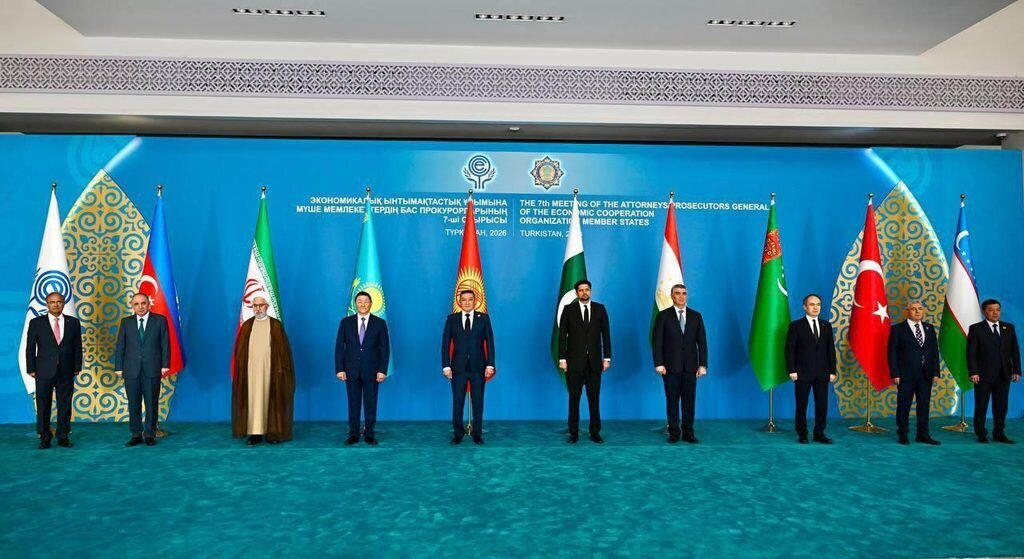
TEHRAN- At the meeting of prosecutors general of the Economic Cooperation Organization (ECO) member states in Kazakhstan, on Friday, September 11, the ECO Secretary General emphasized the need to expedite the operationalization of the “ECO Regional Center for Cooperation among Anti-Corruption Bodies and High Inspectors (Ombudsmen).”
According to IRNA, citing the ECO Secretariat, the Seventh Meeting of Prosecutors General of the Economic Cooperation Organization (ECO) member states was held on Friday, in the city of Turkistan, Republic of Kazakhstan.
Prosecutors general and heads of delegations of ECO member states—including the Republic of Azerbaijan, the Islamic Republic of Iran, the Republic of Kazakhstan (host), the Kyrgyz Republic, the Islamic Republic of Pakistan, the Republic of Tajikistan, the Republic of Türkiye, Turkmenistan, and the Republic of Uzbekistan—actively participated in the meeting.
Assylov Berik Nogayevich, Prosecutor General of Kazakhstan, welcomed the delegations participating in Turkistan and emphasized Kazakhstan’s firm commitment to further strengthening ECO regional cooperation in the field of prosecution and judicial affairs among member states and within the framework of the organization.
ECO Secretary General Asad Majeed Khan, in his opening speech, thanked Kazakhstan for its excellent hosting of the Seventh Meeting of ECO Prosecutors General and stressed the importance of the practical and realistic implementation of the “Interaction Plan among the Prosecutors General’s Offices of ECO Member States,” as well as the speedy operationalization of the “ECO Regional Center for Cooperation among Anti-Corruption Bodies and High Inspectors (Ombudsmen).”
He also referred to Pakistan’s proposal for an “Agreement on Mutual Legal Assistance in Criminal Matters among ECO Member States,” an agreement that would strengthen institutional ties among member states.
The ECO Secretary General noted that the future strategic goals of “ECO-2035” will outline the future roadmap for economic development and prosperity in the ECO region.
It is worth noting that at Friday’s summit in Turkistan, Kazakhstan, the prosecutors general and heads of delegations of ECO member states, while presenting their national statements, held comprehensive and constructive discussions and exchanges of views and expressed confidence that collective efforts would strengthen a coherent and efficient framework for prosecution in the ECO region—a framework that enhances judicial cooperation, institutional capacities, transparency, and accountability.
The meeting also reaffirmed the importance of regularly holding prosecutors general meetings as vital platforms for strategic alignment, mutual confidence-building, and the advancement of regional legal cooperation.
At Friday’s ECO meeting, the Republic of Azerbaijan’s proposal to host the next meeting, as well as the proposals of the Kyrgyz Republic and Turkmenistan to host future events in their countries in cooperation with the ECO Secretariat, were welcomed.
ECO is a regional organization that promotes economic, technical, and cultural cooperation among its member states. In recent years, it has expanded its focus to include legal and judicial dimensions, recognizing that economic integration depends on reliable legal frameworks.
The Seventh Meeting of Prosecutors General in Turkistan therefore represents more than a routine diplomatic event. It reflects a broader effort to build a regional architecture for justice, anti-corruption, and mutual legal assistance. The emphasis on operationalizing the Regional Center, implementing the Interaction Plan, and exploring a mutual legal assistance agreement shows that member states are moving from principles to mechanisms. If these initiatives advance, they could improve cross-border investigations, asset recovery, and integrity-building across the ECO region.
Iran has recorded an 82 percent growth in trade with members of the Economic Cooperation Organization (ECO) over the past five years, a senior trade official announced in April, reaffirming Iran's commitment to strengthening regional economic ties despite ongoing challenges.
Elham Hajikarimi, director of the Revival Office of Trade Agreements and International Organizations at the Iran Trade Promotion Organization, made the announcement during the first meeting of the "Technical Committee for Negotiations on the ECO Trade Agreement (ECOTA)" in Tehran.
"Despite the oppressive sanctions and the imposed war against our country, which has damaged some of our trade and economic infrastructure and created limitations, Iran is fully prepared to actively participate in the ECO and to help formulate a new trade agreement," Hajikarimi stated.
She emphasized that all member countries, beyond the current ECOTA members, can use the existing ECOTA text as a framework to move toward a more comprehensive agreement—one that addresses both present needs and future requirements.
Hajikarimi underscored the necessity of cooperation among all members to realize the ECO 2035 vision, noting that Iran has focused its economic and trade diplomacy on maximum engagement with friendly countries, including ECO member states.
The Economic Cooperation Organization, with its permanent secretariat located in Tehran, comprises 10 member nations: Iran, Turkey, Pakistan, Afghanistan, Azerbaijan, Turkmenistan, Kazakhstan, Kyrgyzstan, Uzbekistan, and Tajikistan.
The organization represents over 500 million people and spans a vast geographic region connecting Central Asia, the Caucasus, the West Asia, and South Asia.
The ECO's primary objectives, outlined in its charter and the 2035 Vision, include facilitating intra-regional trade, improving transportation networks, and eventually establishing a common market. Key frameworks like ECOTA aim to liberalize and boost commerce among members.
In a related development last August, Iran's Transport and Urban Development Minister Farzaneh Sadegh announced that Iran is prepared to provide facilities for landlocked ECO member states to develop multimodal transport links.
Speaking at a meeting of ECO landlocked countries in Turkmenistan, Sadegh highlighted that strengthening transport and transit connections between landlocked and coastal ECO countries is a priority under the Izmir Treaty, the organization's founding document.
Sadegh noted that Iran's strategic location at the crossroads of north–south and east–west transport corridors, combined with 250,000 kilometers of roads, 15,000 kilometers of railway, and 16 commercial ports, positions the country to play a constructive role in regional connectivity.
The recent launch of an ECO freight train connecting Turkey, Iran, and Turkmenistan—part of the Almaty–Tashkent–Ashgabat–Tehran–Istanbul corridor—was cited as a milestone in linking landlocked ECO states to global markets.
Iran has also drafted an "ECO Gate" document aimed at granting landlocked members access to open seas with special port and maritime concessions from coastal members, a proposal awaiting implementation with support from the ECO Secretariat and relevant UN offices.
MA
Leave a Comment